
近日,深圳湾实验室分子生理学研究所李芬芳课题组在超声微气泡物理领域发表题为“Sub-wavelength scale randomly frozen microbubble during short-pulsed-ultrasound-driven microbubble cluster dynamics in microfluidic channel”论文(声学领域期刊Ultrasonics Sonochemistry)。该研究利用模拟血管的微流控芯片与高速显微成像技术,在生理流动条件下揭示了短脉冲超声驱动脂质微气泡团时存在一种独特的“冻结”状态——气泡在亚波长尺度上位移固定却持续振荡,为理解超声联合微泡辅助药物递送中微气泡的复杂行为提供了新见解。
从“聚集”到“冻结”:短脉冲超声作用下的微气泡动力学
聚焦超声联合静脉注射微气泡技术能够非侵入性地打开血脑屏障、辅助药物递送,具有广阔的临床应用前景。然而,微气泡在体内会以“气泡云”的形式存在于流动的较大尺寸的血管中,其群体行为远比单个气泡复杂。尤其是在新兴的短脉冲超声下,微气泡如何在声场与流动的共同作用下演化,此前一直缺乏高时空分辨率的直接观测。
为探索这一谜题,研究团队构建了血管模拟微流控平台——通道宽200 μm、高100 μm,尺寸在真实血管尺度范围内。结合1.125 MHz环形超声换能器与高速相机(最高750,000帧/秒),团队在37.5–150 μL/min的生理流速下,实时捕捉了微气泡云在短脉冲超声(脉冲长度50–100 μs,重复频率1 kHz)中的动态行为(Figure 1)。
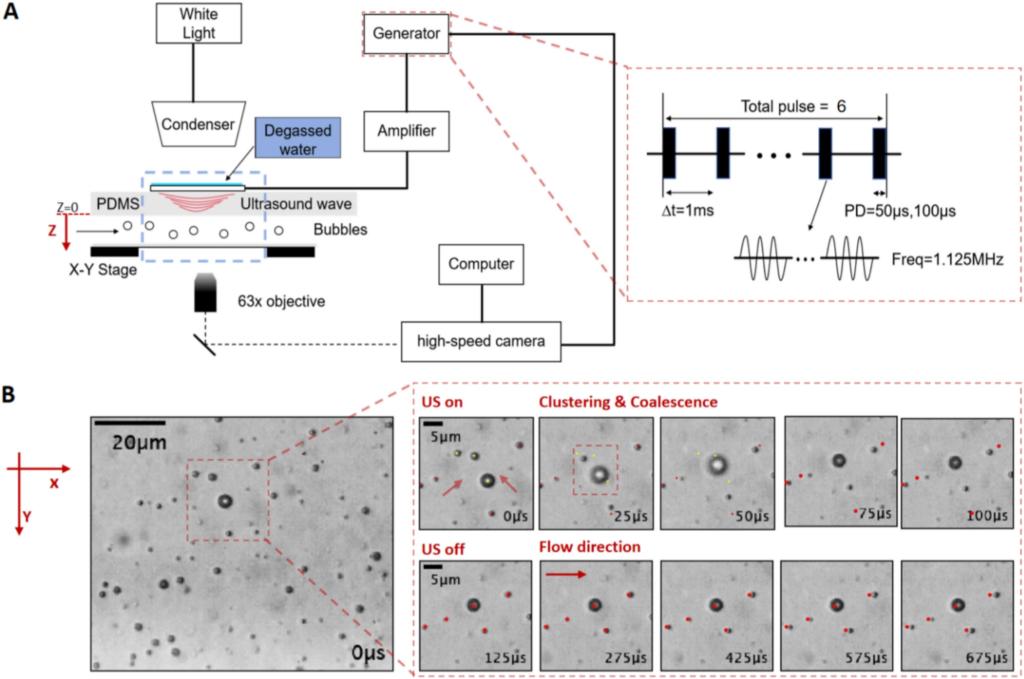
Figure 1. Experimental setup and bubble dynamics recording. (A) Experimental setup and schematic of the short-pulse ultrasound sequence used in the experiments. (B) High-speed snapshots of bubble dynamics under ultrasound excitation and fluid flow (flow rate: 37.5 µL/min; pulse length: 50 µs). Yellow dots indicate the initial positions of bubbles that subsequently coalesced, whereas red dots indicate the initial positions of bubbles that did not coalesce (top row on the right). Bubbles cluster and coalesce during ultrasound excitation and move downstream with the flow once the ultrasound is turned off.
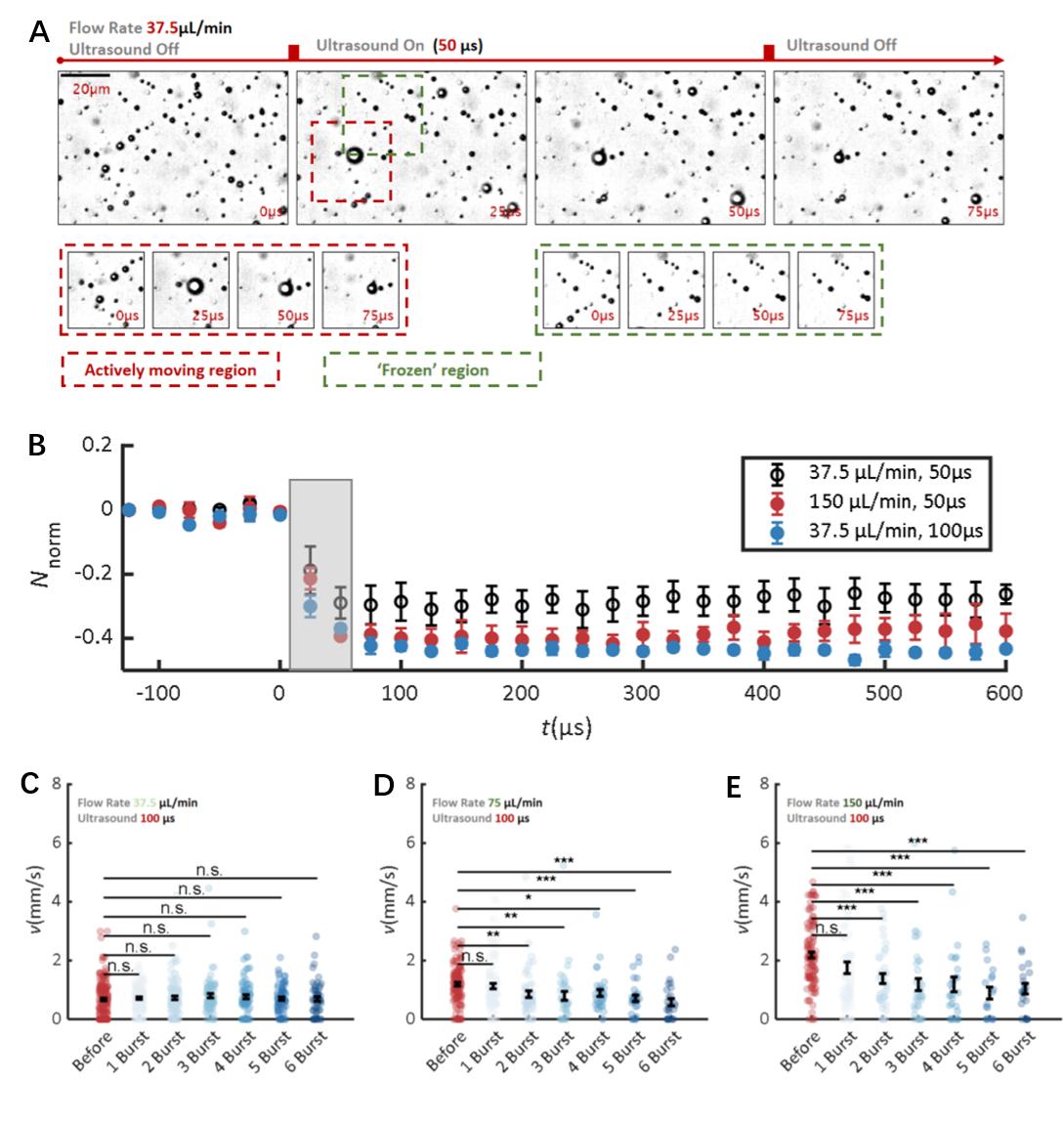
Figure 2. Analysis of bubble motion and bubble dynamics under a single (A-B) or multiple (D-E) shot-pulse ultrasound sequence. (A)Analysis of bubble motion and bubble dynamics under a single shot-pulse ultrasound sequence. Selected images of bubble motion and dynamics under ultrasound excitation at flow rate 37.5 µL/min, and pulse length 50 µs; (B) Microbubble number as a function of time under different conditions. The shaded region indicates the application of the 1st ultrasound pulse. Error bars indicate the standard deviation obtained from independent realizations. Each data represents Mean ± SEM. Three individual videos are analyzed in each of the three conditions. (C-E) Statistical analysis of microbubble velocity under different conditions: (C) flow rate 37.5 μL/min, pulse length 100 μs; (D) flow rate 75 μL/min, pulse length 100 μs; (E) flow rate 150 μL/min, pulse length 100 μs.
高速成像揭示了一个此前未被报道的现象:微气泡云存在两种截然不同的状态。一是活跃相互作用区,微气泡发生明显的聚集与合并;二是“冻结”区,微气泡在持续超声激励下位移极为微小 (Figure 2 A)。两种状态都会导致亚波长尺度(小于0.1λ)上形成空间固定但持续振荡的微气泡。在冻结区观察到聚集的冻结微气泡团,而在活跃区则可见相对较大的孤立微气泡。
“冻结”的物理本质:声辐射力与近壁流体动力的动态博弈
那么,微气泡为何会“冻结”?研究团队通过理论建模给出了答案。
在短脉冲超声作用下,微气泡受到两种主要力量的博弈:一是声辐射力(声场的主级Bjerknes力和邻近气泡间相互吸引的次级Bjerknes力),驱动气泡聚集和运动;二是近壁流体动力阻力——当气泡靠近PDMS通道壁面时, lubrication效应使平行于壁面的运动受到抑制 (Figure 3 )。理论模型表明,当气泡-壁面间隙缩小到一定程度时, hydrodynamic drag急剧增大,气泡的平移运动被有效“锁死”。
流量在这一过程中扮演了双重角色。低流速(37.5 μL/min)下,浮力主导使气泡自然靠近壁面,更容易进入“冻结”状态;高流速(150 μL/min)下,壁面lift force将气泡推离壁面,气泡在早期表现出更强的聚集和合并 (Figure 2B, Figure 3B)。然而,无论初始状态如何,随着短脉冲超声的反复作用,壁面诱导的流体动力最终将气泡拉向壁面,使其“冻结” (Figure 2 C-E)。脉冲长度则主要影响早期相互作用阶段:更长的脉冲(100 μs)延长了次级Bjerknes力的作用时间,导致更显著的聚集和合并。
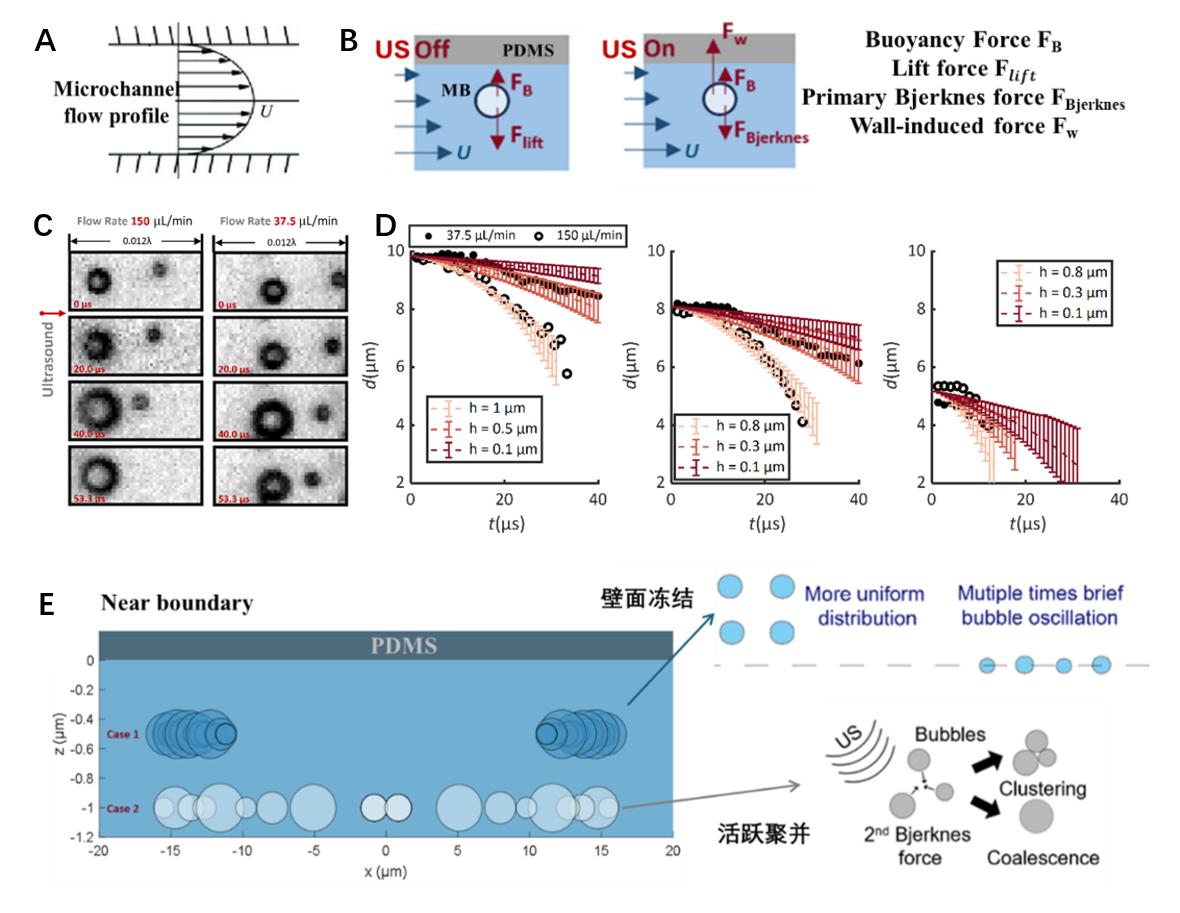
Figure 3. Physical analysis of vertical and lateral microbubble motion. (A) Poiseuille flow profile in the microchannel z direction, indicating velocity gradient and shear gradient near the wall. (B) Forces acting on the microbubble during ultrasound off and ultrasound on. (C-D) Experimental and simulation results of the bubble motion parallel to the wall: (C) Selected high-speed experimental images showing the motion of an unequal-sized microbubble pair under different flow rate. During the ultrasound excitation, the small microbubble is attracted by the large one. (D) The comparison between experimental and simulation results on bubble–bubble distance d v.s. time, where the radius of the large microbubble is 1.6 µm. Simulations with various small microbubble radius (R0∈ [0.7,1.1] µm) are conducted, indicated by the error bar, to exclude the influence of the bubble radius on the simulation results. The microbubble coalescence is observed under high flow rate conditions in all conditions, and under low flow rate conditions in the right panel. (E) Schematics showing different bubble dynamics. Case 1 indicates ‘frozen’ states near the PDMS wall. Case 2 represents ‘actively interacting’ zone.
从“冻结”到治疗:对超声药物递送的设计启示
首先,“冻结”状态的存在意味着治疗结果对局部血流环境高度敏感 (Figure 3E)。在血流缓慢的肿瘤血管中,微气泡可能迅速进入“冻结”状态,在血管壁附近产生持续、局部的机械应力——这可能有利于增强药物的血管外渗。而在血流较快的健康血管中,气泡则可能保持活跃运动,与更大面积的内皮细胞相互作用。
其次,“冻结”状态本身可能代表一种独特的生物效应机制——一个被“锁”在血管壁附近却持续振荡的微气泡,能够产生持续的局部剪切应力,可能比短暂相互作用的自由漂浮气泡更有效地触发特定的细胞响应,如钙信号或机械敏感通道的激活。
该研究还发现,增加脉冲长度和流量均会导致气泡数量更显著的下降,且气泡振荡幅度主要由平衡半径决定,而非由“冻结”或活跃状态决定——这意味着“冻结”气泡并非“失活”,而是依然在局部持续地进行声学活动。
深圳湾实验室李芬芳研究员、德国马格德堡奥托·冯·格里克大学范雨喆博士和北华大学王立英教授为本文的共同通讯作者,李芬芳课题组硕士生罗思宇和研究助理王玉杰为本文的第一和第二作者。该研究得到了国家自然科学基金、广东省自然科学基金及深圳湾实验室启动经费等项目的支持。
李芬芳课题组长期招收以下方向博士后、博士生:1)声学微流控,空化流体力学;2)治疗超声、超声成像; 3)生物物理。欢迎联系课题组PI: fenfang.li@szbl.ac.cn。课题组网站信息详见https://liff-lab.szbl.ac.cn/research/。
原文信息:
Sub-wavelength scale randomly frozen microbubble during short-pulsed-ultrasound-driven microbubble cluster dynamics in microfluidic channel
供稿 | 李芬芳课题组
编辑 | 鲍 啦
责编 | 远 山
欢迎投稿、建议 | media@szbl.ac.cn




 粤公网安备44031102000926号